Start at the Right Moment with an If-Then Plan
Connect a goal to a recognizable situation and a small action, so the right moment no longer requires a fresh decision.
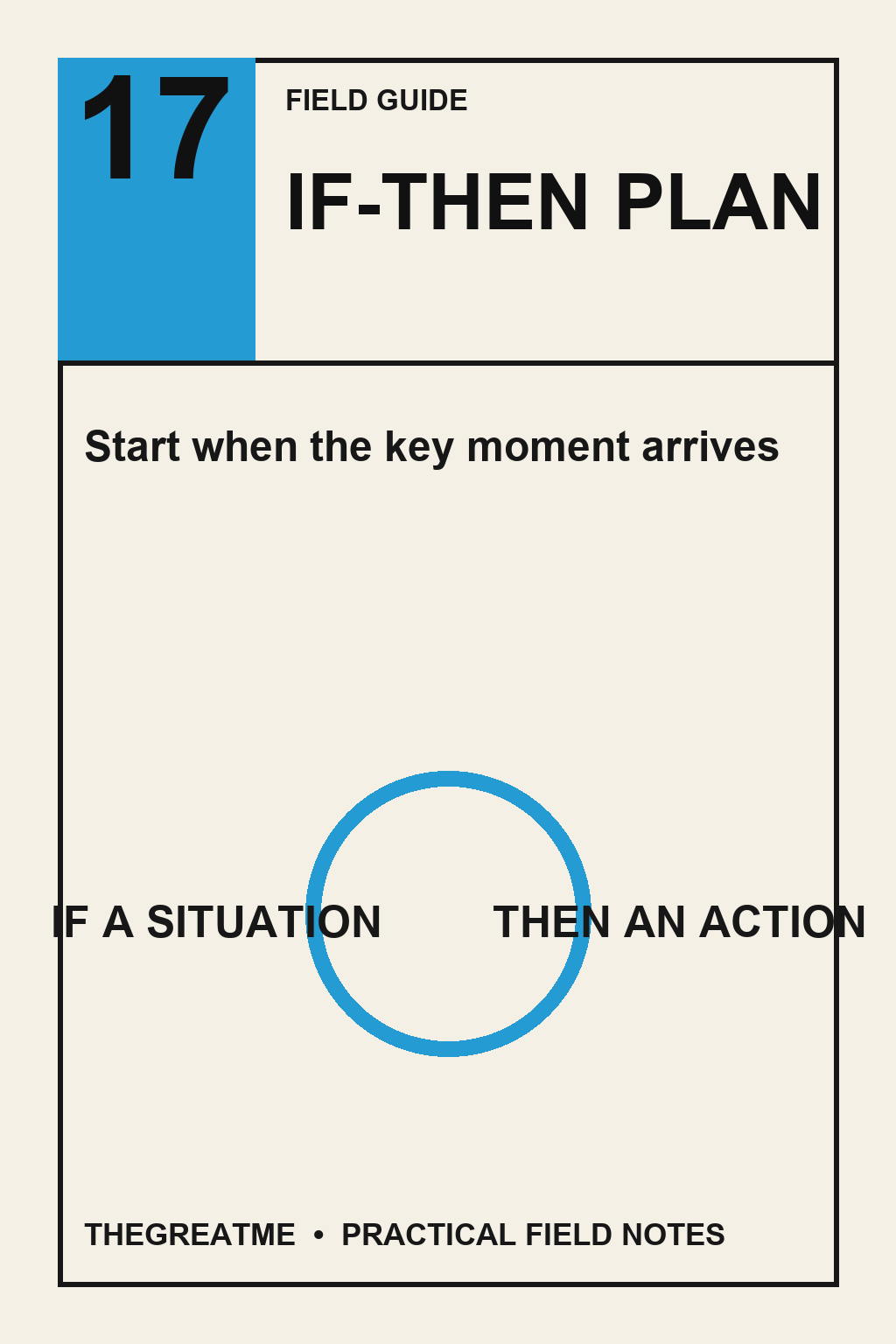
In brief Use an If-Then Plan to connect a goal you've already chosen to a recognizable situation and a minimal action, so key moments no longer require re-deciding, get postponed, or slip your mind.
The Opening Question: Why Doesn't a Sincere Intention Show Up at the Key Moment?
"I want to write every day." "I'm going to start exercising." "This week I will definitely contact that client." These intentions can be completely sincere. Yet when evening comes, when the meeting ends, or when pressure spikes, you still open the familiar app, handle low-value chores, and only later remember the original plan. The goal is already chosen — why doesn't the action appear at the key moment?
"I want to" means you've accepted an outcome, but it never specified which real-world signal launches which action. When the key moment arrives, your brain still has to recognize the opportunity, pick an action, and outcompete old habits — all at once. An If-Then Plan does that pairing in advance.
What Is an If-Then Plan?
An If-Then Plan is known in psychology as an implementation intention. The basic sentence is:
If situation X appears, then I perform action Y.
X should be a recognizable time, place, preceding event, or key state — for example, "Tuesday's stand-up ends and I'm back at my desk." Y should be a clear behavior you can start on the spot — for example, "open the draft and write three subheadings." Compare that with "if I have time, I'll push the project forward": both ends are vague. "Have time" can't be reliably recognized, and "push forward" has no first action.
A goal intention answers "what result do I want"; an implementation intention answers "when, where, and how do I start." It works after you've personally chosen the goal, and it handles three kinds of moments: seizing an opportunity to act, starting a hard task, and switching back to the goal when distractions or old habits show up.
Where It Comes From: Gollwitzer's Implementation Intentions
Peter Gollwitzer laid out implementation intentions systematically in his 1999 review: linking an anticipated situation to a goal-directed response makes it easier to launch the action quickly when the situation appears. Follow-up studies by Brandstätter, Lengfelder, and Gollwitzer examined action initiation under high cognitive load.
Gollwitzer and Paschal Sheeran's 2006 meta-analysis pooled 94 independent tests and reported a medium-to-large positive effect of implementation intentions on goal attainment. That overall result does not mean any if-then sentence works. If goal commitment is weak, if the trigger never occurs, or if the action exceeds your capacity at that moment, the plan still fails — and it cannot decide for you whether a goal is worth pursuing.
A Concrete Case: The Weekly Commentary That Kept Slipping to Midnight
A fictional case. Product manager Zhou Ning decides to publish a short industry commentary every Wednesday. She puts "finish the draft on Tuesday" in her calendar — but Tuesday mornings start with messages, afternoons get shredded by meetings, and for three straight weeks the draft slips to late night.
Reviewing the scene, she notices that 9:30 on Tuesday, right after the stand-up, is a stable window — and the real derailment happens when she returns to her desk and opens the chat app first. So she writes:
If Tuesday's stand-up ends and I return to my desk, then I open the commentary draft and write three subheadings before checking chat messages.
The sentence doesn't demand a finished article on the spot. It pre-claims the first visible action and ties it to an event that reliably occurs. If the stand-up gets canceled, the trigger doesn't appear and the plan simply doesn't execute — that should be logged as a design issue, not a willpower failure.
The Method: Seven Steps to a Plan That Fires
- Confirm the goal first. Write plans only for goals you've already committed to. If you're still comparing directions, do the value and feasibility judgment first.
- Find the real key moment. This article suggests reviewing a few recent delays to locate where action could have started or most easily derailed.
- Choose a recognizable trigger. Prefer stable preceding events — "after lunch," "closing the stand-up window." Avoid "when I feel good" or "later."
- Shrink Y to the first action. This article recommends an action small enough to start immediately: putting on shoes, opening the file, or sending the first email. The research does not prescribe a universal time limit.
- One pairing per sentence. One X to one Y. Multiple branches turn the moment back into a multiple-choice question.
- Rehearse once. Walk through the sequence mentally — situation appears, signal recognized, action performed — and stage the needed materials in advance.
- Review by trigger counts. Record how many times X appeared and how many times Y was completed. If X rarely appears, change the trigger; if X appears but Y keeps failing, shrink the action further or remove friction.
A Prompt You Can Copy
Prompt template
Help me design an If-Then Plan for a goal I have already chosen. Ask first — don't hand me a plan directly:
1. What goal have I decided to pursue? Have I personally confirmed this choice?
2. In a few recent moments when I could have started but didn't, what happened each time?
3. Which of these are observed facts, and which are just my assumptions about why I procrastinate?
4. Which time, place, or preceding event occurs reliably?
5. At that moment, what is the smallest first action I can actually perform?

After my answers, output:
- Goal intention: restate only the goal I have confirmed
- Facts: information that happened and is observable
- Assumptions: causal judgments still needing verification
- Primary If-Then Plan: if [single, recognizable situation], then I [single, specific action]
- How to handle days when the trigger doesn't appear
- Short validation period: count of X appearing, count of Y completed
- Questions you need me to confirm

Do not judge which goal is more valuable for me, do not present speculation as fact, and do not use abstract actions like "try harder" or "stay disciplined." Keep asking if information is insufficient.
How to Run It in TheGreatMe
Use a weekly goal to confirm the result you want, then write the If-Then Plan into the task text: "If Tuesday's stand-up ends and I'm back at my desk, write three subheadings first." If it fails, use biggest blocker to record whether the trigger never appeared or the action was still too difficult to start. Those two facts call for different revisions.
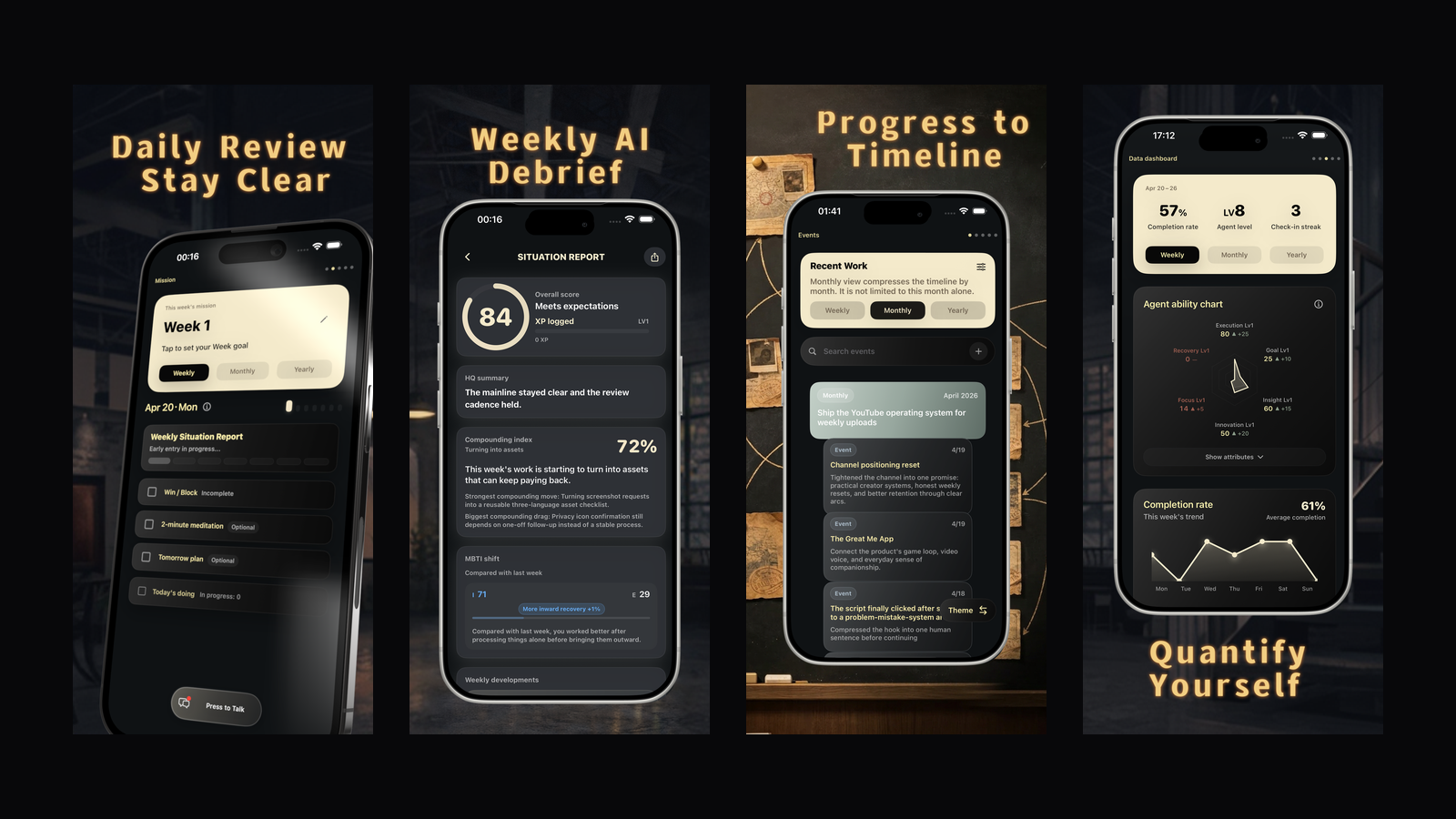
Illustrative English product screens. Values shown are sample app content, not research findings.
View TheGreatMe on the App Store
Common Mistakes
Watch for this — Writing the trigger as "when I have time" You can never clearly tell when it has arrived.
Watch for this — Writing Y as the whole project The key moment only needs the first action launched; the task list can carry the rest.
Watch for this — Automating a goal you haven't chosen Implementation intentions improve execution; they don't make value choices.
Watch for this — Stuffing multiple actions into one situation The moment becomes a sorting exercise again, weakening the pairing.
Watch for this — Relying on clock reminders alone If the reminder fires while you're in the wrong place with nothing prepared, starting is still hard.
Watch for this — Blaming failure on lack of discipline Check whether X appeared and whether Y was feasible before judging the plan.
Start Today
Start here — Check one box and you've started
- [ ] Pick one confirmed goal that needs to launch within the next seven days.
- [ ] Recall the last scene where you could have started but drifted.
- [ ] Write down a time, place, or preceding event that will genuinely occur.
- [ ] Shrink the action to a first step you can start immediately.
- [ ] Complete one sentence: "If X, then I do Y."
- [ ] Stage the files, clothes, or tools in advance.
- [ ] After a short test period, count X and Y separately — not just the end result.
FAQ
How is an If-Then Plan different from an ordinary to-do?
A to-do says what to do; an If-Then Plan also specifies which situation, the moment it appears, launches which action. They combine well.
Can one task have multiple if-then plans?
Yes, but start with the single most common key moment. Once the primary plan is stable, add backup plans for frequent exceptions — avoid branch overload.
What if the trigger doesn't appear that day?
Don't count it as an action failure. Record why the trigger was absent, then choose a more stable preceding event or set a backup trigger for the known exception.
Does an If-Then Plan make action effortless?
No. It reduces the burden of on-the-spot recognition and decision. Task difficulty, emotion, resources, environment, and goal commitment still affect execution.
References
- Gollwitzer, P. M. (1999). Implementation intentions: Strong effects of simple plans. American Psychologist, 54(7), 493-503.
- Gollwitzer, P. M., & Sheeran, P. (2006). Implementation intentions and goal achievement: A meta-analysis of effects and processes. Advances in Experimental Social Psychology, 38, 69-119.
- Brandstätter, V., Lengfelder, A., & Gollwitzer, P. M. (2001). Implementation intentions and efficient action initiation. Journal of Personality and Social Psychology, 81(5), 946-960.