Make Faster Decisions with the OODA Loop
Use the OODA Loop to observe changes, update your understanding, choose the next move, and turn action into new feedback.
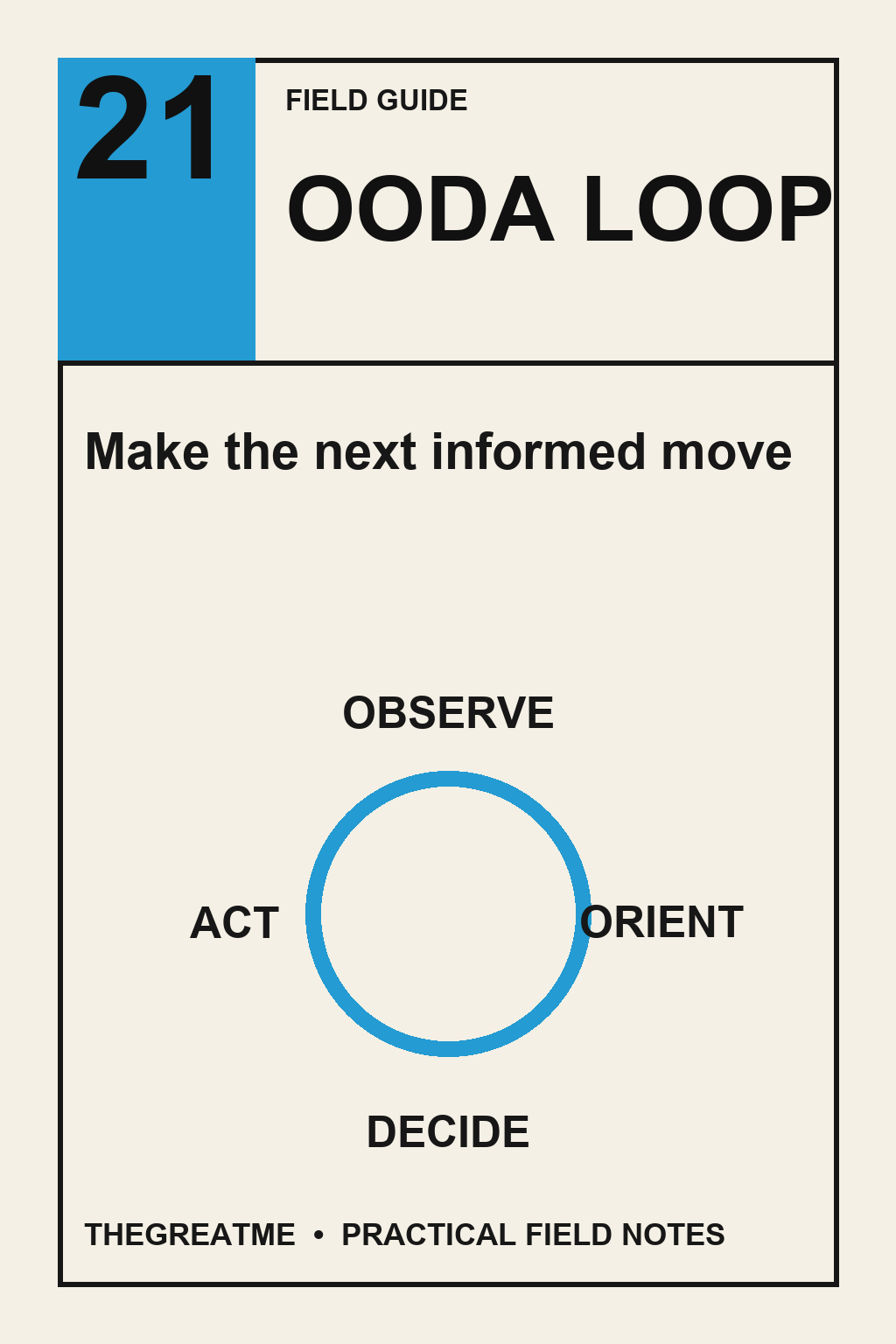
In brief Use the OODA Loop to keep observing, recalibrate your understanding, choose the next step, and turn action into feedback in fast-changing situations — without mistaking fast decisions for rushed ones.
The Opening Question: What Should "Deciding Faster" Actually Mean?
When market news, user feedback, collaboration conditions, and time windows all shift at once, the original plan expires fast. Some people keep collecting information and never act; others decide instantly "to stay ahead" and only discover afterward that their basis was already stale. What actually needs compressing is the time between a new fact appearing and the next round of useful feedback.
The OODA Loop condenses this process into Observe, Orient, Decide, Act. Fast does not mean rushing all four steps. Effective speed comes from spotting changes earlier, updating your understanding more accurately, choosing a next step that's small enough, and letting the action produce observable results as soon as possible.
What Is the OODA Loop?
The OODA Loop — often called the decision cycle — has four phases:
- Observe: Collect external changes, results of your actions, and your own state, noting time and source.
- Orient: Place the new information within your goals, experience, culture, capabilities, constraints, and analytical models to form your current interpretation.
- Decide: Choose a direction for action. Boyd's final diagram labels the decision a "hypothesis."
- Act: Execute and receive feedback from the environment. The diagram labels action a "test."
It is not a closed four-box sequence. Boyd's diagram contains multiple feedback, feedforward, and "implicit guidance and control" paths: new observations directly reshape orientation, and actions continuously change the environment. Orient is the pivotal hub — the same fact filtered through different experience, assumptions, and goals produces different judgments. Speeding up the button-clicking without updating your orientation usually just means executing an outdated understanding faster.
Where It Comes From: John Boyd
The OODA Loop comes from U.S. Air Force Colonel John R. Boyd's long study of air combat, strategy, organizations, and adaptation. Air University Press published A Discourse on Winning and Losing in 2018, collecting Boyd's original briefing system. The book's appendix notes that the widely circulated 1987 briefings did not contain the final OODA diagram; Boyd presented the final compressed version in The Essence of Winning and Losing on June 28, 1995.
The U.S. Marine Corps' MCDP 1: Warfighting refers to it as the decision cycle, OODA loop, or Boyd cycle, explaining that action creates a new situation and the cycle begins again — and that consistently completing effective cycles faster than an opponent creates a tempo advantage.
For individuals and teams, treat it as a framework for dynamic judgment, not a formula that guarantees success. "Faster" in military competition does not transplant directly to medicine, investing, law, or irreversible life decisions. High-consequence situations demand stricter evidence, professional advice, and safety procedures.
A Fictional Case: 42 Signups, 48 Hours to Launch
The numbers in this fictional example are illustrative, not product data or research findings. Imagine Chen is launching an online course on Friday. On Wednesday morning, signups stand at 42 against a target of 80. The team's original plan was to increase ad spend — but the ad dashboard, emails, and interviews are bringing in new information.
First observation round: Click-through rates match past averages and landing-page traffic is decent; checkout completion is clearly low; three of five prospective users say "I can't tell what level this course is for." These are facts with sources and timestamps. "The price is too high" remains only a guess.
Orient: The current goal is to identify the main obstacle within 48 hours, not to fix every conversion problem at once. Traffic is adequate, so the problem more likely sits in the comprehension-and-trust stage; the sample is tiny, so no cause can be declared. Course content, refund policy, and start date stay unchanged for now.
Decide: Adopt "unclear audience and outcomes are causing checkout drop-off" as the current hypothesis. Choose one reversible action: rewrite only the hero section to state who the course fits, what they'll be able to do afterward, and include a sample lesson — and hold the ad budget steady. Acceptance criterion: hero-to-checkout conversion six hours later. Guardrail: refund inquiries and support questions must not rise.
Act: Ship the change at noon and send the same messaging to the high-intent email list. Six hours later, new data arrives and the second loop begins. If conversion improves, check actual payments next; if nothing changes, test price, payment failures, or trust issues.
The value of this cycle isn't guessing right the first time. It's that the team didn't burn the remaining 48 hours in debate — and didn't change price, page, and ads simultaneously, which would have made the result impossible to interpret.
The Method: Seven Moves for Faster, Better Loops
1. Set a decision deadline first
Write down "the latest moment I must act" and "how long until feedback arrives." The time window determines how deep to gather information. Small reversible decisions can run short loops; irreversible, high-loss decisions should slow down and add review.
2. Keep a timestamped observation list
Collect only information that would change your next step, noting source, time, reliability, and gaps. Keep "users say they can't understand it" separate from "users don't like the product" — the first is an observation, the second an interpretation.
3. Update your orientation
This article's personal-use adaptation checks five areas: current goal, hard constraints, old assumptions, likely biases, and alternative explanations. Ask: "If the newest facts are true, which part of my earlier understanding needs updating?"
4. Write the decision as a hypothesis
Use the pattern: "Based on A and B, I tentatively believe C, so I choose D; if E appears, I stop or change course." This makes the decision testable against results, and later helps you separate judgment quality from luck.
5. Choose the smallest effective action
The action must be enough to change the environment or produce new information, while minimizing irreversible cost. Shipping one prototype, contacting five target users, or pausing one channel often generates evidence faster than a long meeting.
6. Pre-set the trigger for the next round
Don't wait until it "feels about time" to review. Set a time, threshold, or event trigger that fits the decision. A later check-in, a meaningful complaint threshold, or a key partner's reply are examples, not rules from the original OODA model.
7. Record the loop, not just the final decision
Keep the facts you saw at the time, your interpretation, your choice, and the result. Only then can a later review tell whether the problem was a missed observation, a biased orientation, a poor choice, or incomplete execution.
How to Run It in TheGreatMe
In TheGreatMe, use event tracking to preserve observations with their time and source. Later, use the AI HQ weekly review to separate facts, interpretations, decisions, and results across several rounds. The AI can organize the record, but goal trade-offs, high-consequence risks, and final decisions remain with you and the relevant professionals.
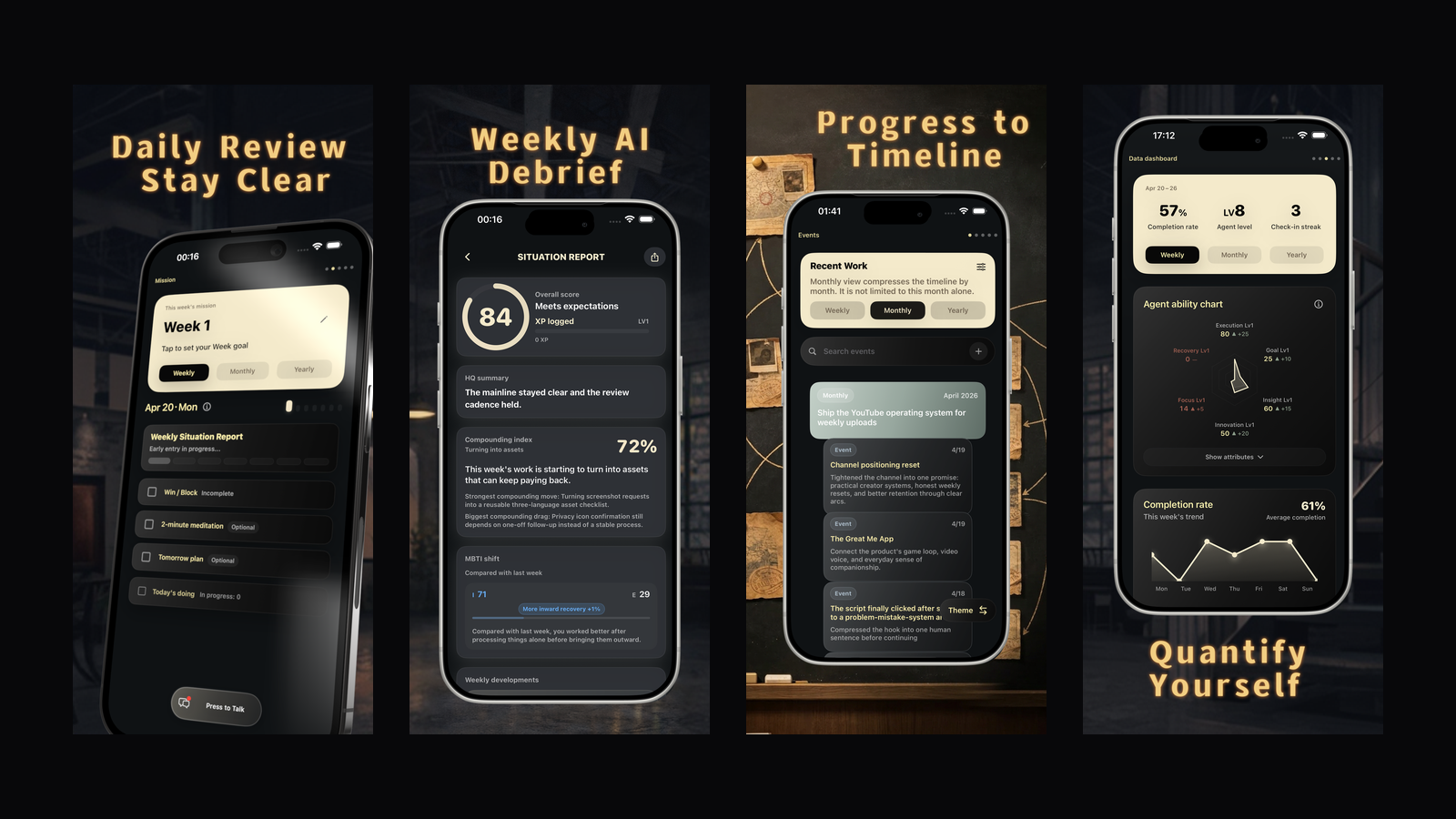
Illustrative English product screens. Values shown are sample app content, not research findings.
Common Mistakes
Watch for this — Drawing OODA as a strict sequence The real loop has continuous feedback and feedforward; when a new fact overturns your interpretation, update your orientation immediately.
Watch for this — Confusing fast with less thinking Speed comes from cutting useless waiting and shortening the distance to feedback. Major, irreversible decisions need slower loops.
Watch for this — Observing only the outside, never yourself Your time, capability, fatigue, and commitments are part of the environment too — they shape which options are actually executable.
Watch for this — Changing several variables at once The action feels bigger, but you can't tell which change produced the result, and the next orientation gets blurrier.
Watch for this — Writing decisions as conclusions "Users just think it's too expensive" closes off exploration. "Price is the current hypothesis, to be tested with this evidence" stays correctable.
Watch for this — Chasing "always faster than everyone" For personal practice, the useful goal is updating your understanding faster than the environment invalidates it — not manufacturing constant urgency.
Start Today
Start here — Check one box and you've started
- [ ] Write down your decision deadline and how reversible the decision is.
- [ ] Record three new facts with sources and timestamps.
- [ ] Separate observations, interpretations, assumptions, and unknowns.
- [ ] Check your current goal, constraints, and old premises.
- [ ] List at least one alternative explanation.
- [ ] Choose the smallest action that yields key feedback fastest.
- [ ] Write down acceptance metrics, stop conditions, and risk guardrails.
- [ ] Set a time or event trigger for the next round.
References
- Boyd, J. R. (2018). A Discourse on Winning and Losing. Air University Press. Includes the 1987 briefing system and the appendix with the final 1995 OODA diagram.
- Air University Press. A Discourse on Winning and Losing: Publication Page.
- United States Marine Corps. MCDP 1: Warfighting.
- Air Force Culture and Language Center. Cultural KSAs: Skill Development Using the OODA Loop.