Turn Weekly Reviews into Action with PDCA
Apply PDCA to turn a weekly review into a testable plan, useful evidence, and a concrete adjustment for the week ahead.
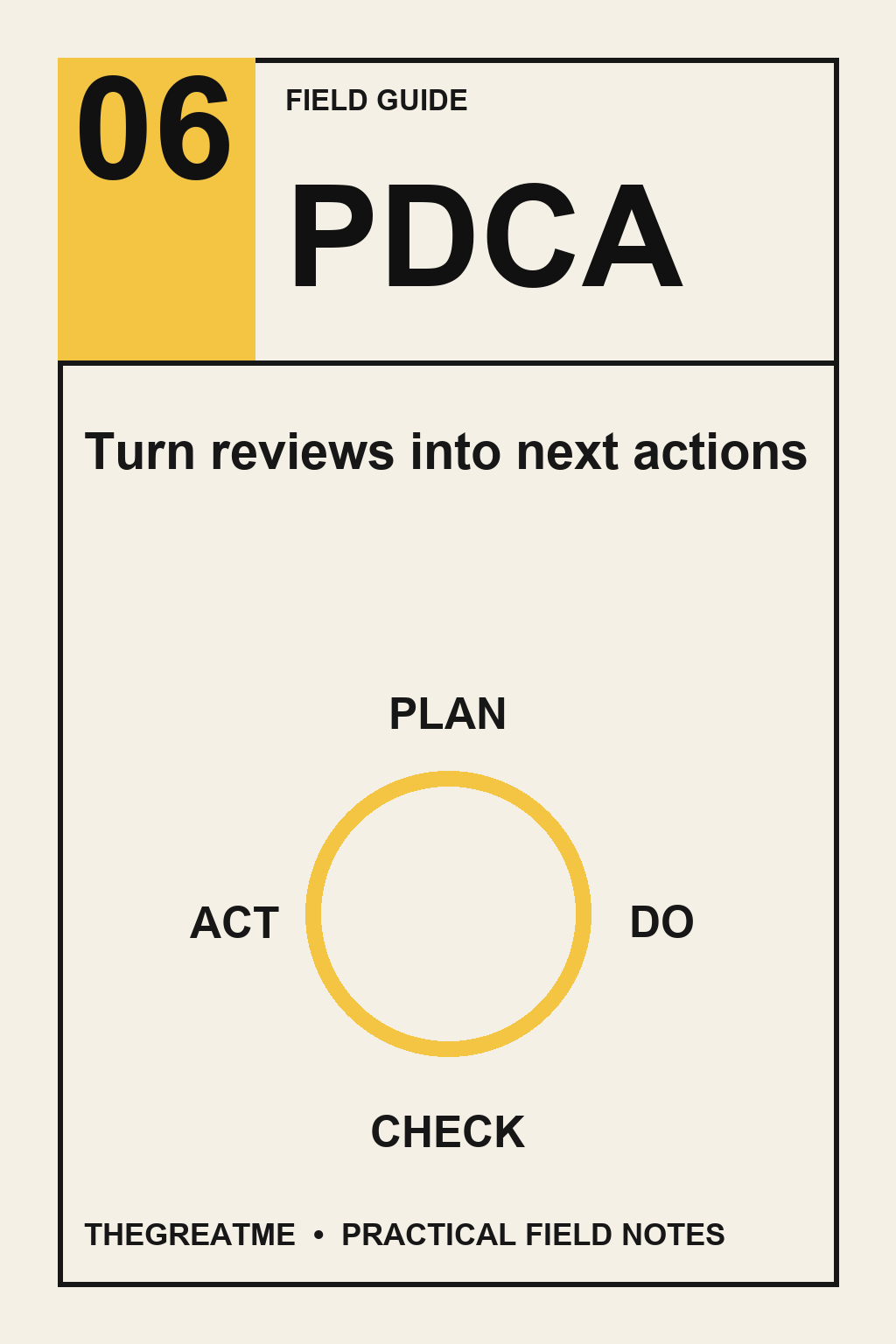
In brief Apply PDCA to your personal weekly review: propose a testable plan, execute in small steps, check the evidence, and write the learning into next week's actions.
The Opening Question
Why do so many reviews diagnose the problem accurately, only for next week to repeat it? The usual gap: the review stops at "Check" and never enters "Act" — or next week's plan is still just "try harder" and "start earlier," with no change that can actually be tested.
PDCA offers a clear path: Plan, Do, Check, Act. Treat one week as one small cycle, and the weekly review stops being the end of the cycle — it becomes the input to the next round of planning.
What Is PDCA?
PDCA is a four-step loop for implementing change and continuous improvement:
- Plan: Define the problem or opportunity, propose a change, and write the expected result and judgment criteria in advance.
- Do: Execute the change at a small scale while recording the process — don't roll it out everywhere at once.
- Check: Compare expectation with reality; analyze the data, exceptions, and side effects; extract what was learned.
- Act: Decide based on the learning: keep, adjust, stop — or start the next cycle with a new hypothesis.
Its greatest value is rewriting "action" as an experiment. The plan contains a prediction; the execution contains records; so the check has comparable evidence — and Act can decide the next step instead of repeating the old slogan.
Where It Comes From
The American Society for Quality (ASQ) defines PDCA as a repeating four-step model for change, recommended for new improvement projects, recurring processes, data collection, and continuous improvement. Its steps specifically emphasize: run a small-scale test in the Do stage, analyze results and learning in Check, and only in Act decide whether to expand the change or start a new cycle.
One distinction is worth making precisely: the W. Edwards Deming Institute notes that Deming himself emphasized PDSA (Plan–Do–Study–Act) — the third step is Study, not Check. Study puts more weight on comparing predictions against actual results to revise your theory. Modern PDCA practice can absorb exactly that: checking shouldn't just be ticking boxes or declaring pass/fail, but answering "what did this result do to my original hypothesis?" This article keeps the more common name PDCA, while giving the Check stage that learning orientation.
An Illustrative Case
The following fictional example shows one way to adapt PDCA to a personal weekly review. Zhou is pushing a yearly goal of "publish 12 professional articles," with a monthly goal of 4. The first two weeks of the month each produced only half an article — apparently because "work is too busy." He used PDCA to design week three:
Plan. Problem defined as "writing starts too late, and the weekend carries too much of the load." Hypothesis: if the material and rough draft are done on weekdays, Saturday only needs editing, and one article can ship. Plan: outline Monday; write one section for 30 minutes each Tuesday through Thursday; patch gaps Friday; publish Saturday. Success criteria: at least a 1,200-word rough draft by Thursday night, live by Saturday 6 p.m.
Do. Monday's outline: done. Tuesday: a surprise meeting, no writing. Wednesday and Thursday: 40 minutes each, 1,050 words total. Friday: rough draft completed. Saturday: published. Each day he logged actual time, word count, and interruption causes.
Check. The publishing goal was met, but "1,200 words by Thursday" wasn't. The evidence showed weekday pre-writing genuinely lightened Saturday; a fixed 30 minutes per day couldn't survive meeting churn — managing by "cumulative draft by Thursday" was steadier. A bonus finding: the outline took 50 minutes, over its estimate.
Act. Keep "rough draft on weekdays." Replace fixed daily writing with three cumulative 40-minute blocks between Monday and Thursday. Cap the outline at 30 minutes. If Thursday's draft is under 1,000 words, shrink the article's scope rather than delay the publish date.
This cycle didn't prove any method works forever. It produced something better: a new version tuned to Zhou's actual weekly rhythm.
The Method
1. Plan: rewrite the wish as a hypothesis
Write four things: the problem to improve this week, the one variable you'll change, the expected result, and the judgment criteria. Example: "If I lay out my running clothes before bed, I'll complete 3 weekday morning runs; the standard is at least 20 minutes each."
2. Do: shrink the test
For a personal review, this article suggests beginning with a short, bounded test whose result can actually be observed. Record actions and key interference. Don't bolt on five new rules because day one went badly; the deviation itself is evidence.
3. Check: compare prediction with result
Answer in order: Did the prediction come true? Which records support that judgment? What surprises appeared? Should the original hypothesis be kept, revised, or dropped? Also check side effects — did higher output cost you sleep?
4. Act: choose the next treatment
For personal use, this article adapts Act into four practical choices:
- Keep: The method works at an acceptable cost — write it into next week's standing practice.
- Adjust: The direction seems right, but the timing, scope, or trigger needs to change.
- Stop: The evidence doesn't support it — don't continue just because you invested.
- Expand: Only after the small-scale test is stable do you increase frequency or scope.
A Prompt You Can Copy
Prompt template
Guide me through this week's review using PDCA. Do not jump to solutions, and do not judge whether my goal is worth pursuing.

Phase one: ask questions and wait for my answer to each:
1. Plan: What did I want to improve this week? What plan did I follow? What were my hypothesis, expected result, and judgment criteria?
2. Do: What did I actually do? How many times? What deviations, interruptions, or last-minute changes happened?
3. Check: How did results differ from the prediction? Which conclusions have records behind them? What side effects or unknowns appeared?
4. Act: Do I want to keep, adjust, stop, or expand this practice? Let me choose.

Keep probing when information is missing — never fabricate data. Once I've answered everything, output:
- A concise PDCA comparison table
- Hypotheses verified, refuted, and still untested
- A next-week plan that changes only one variable
- Explicit trigger conditions, execution frequency, acceptance criteria, and a fallback

Recommendations must respect my constraints and offer at least two options with their costs — the decision is mine.
How to Run It in TheGreatMe
In TheGreatMe, write the hypothesis and success criteria into a weekly goal. During the AI HQ weekly review, compare the original prediction with the week's actual records, then choose one practice to keep or one variable to change. The app provides the record and review space; the choice remains yours.
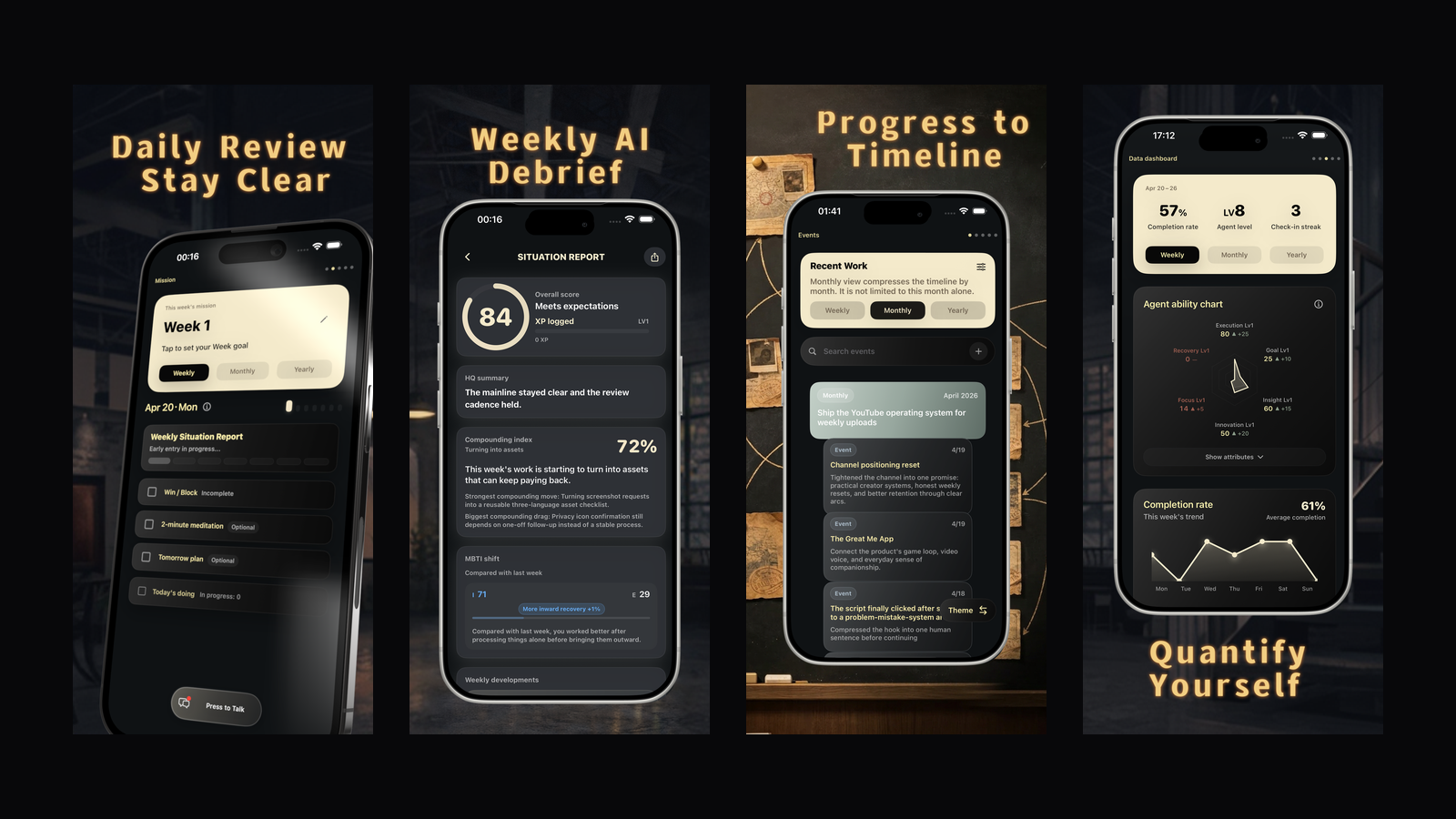
Illustrative English product screens. Values shown are sample app content, not research findings.
Common Mistakes
Watch for this — Writing Plan as a task list "Read, exercise, write" has no problem definition, hypothesis, or standard — so Check can only count checkmarks.
Watch for this — Changing everything in the Do stage Rolling an unproven method across the whole week makes failure expensive and causes impossible to isolate.
Watch for this — Check that only reads completion rates Completion rate describes the result; it can't explain it alone. Also examine time, quality, blockers, and side effects.
Watch for this — Act that means "keep trying harder" Act must issue a real decision and feed the next Plan. Copying the old plan unchanged usually means no learning was absorbed.
Watch for this — Mistaking a fluctuation for a trend One improved week may just mean more free time or a lucky break. Observe across multiple cycles before expanding a practice.
Start Today
Start here — Check one box and you've started
- [ ] Pick one recurring problem that's small enough in scope.
- [ ] Write down the single variable you'll change.
- [ ] Write an "if... then..." prediction.
- [ ] Set one outcome metric and one process metric.
- [ ] Record execution counts, key interruptions, and side effects.
- [ ] Compare prediction with reality at the weekend — don't just declare success or failure.
- [ ] Choose one: keep, adjust, stop, or expand.
- [ ] Write the decision into next week's concrete actions.
FAQ
What are the four steps of PDCA?
Plan, Do, Check, Act. When all four finish, the next cycle begins, continuously refining the method with new evidence.
Is PDCA suitable for a personal weekly review?
Yes — especially for changing recurring behavior, workflows, or study methods. For personal use, shrink the scope and keep process records.
What's the difference between PDCA and PDSA?
The third step. PDCA uses Check; PDSA uses Study, which puts more weight on comparing predictions with results to revise your knowledge or theory. The Deming Institute states explicitly that Deming himself emphasized PDSA.
Why does PDCA so often stall at Check?
Because inspecting results is easy and making trade-offs is hard. The fix: require every review to end in one of keep, adjust, stop, or expand — and write it straight into the next cycle's plan.
How long should one PDCA cycle be?
As long as the result takes to observe. For personal habits, start with a week; processes needing faster feedback can cycle daily; slow variables like health and skills need multiple cycles — never conclude from a single week.