Run a Useful Review with Three Questions
Use What, So What, Now What to reconstruct an experience, identify what it means, and choose one useful next action.
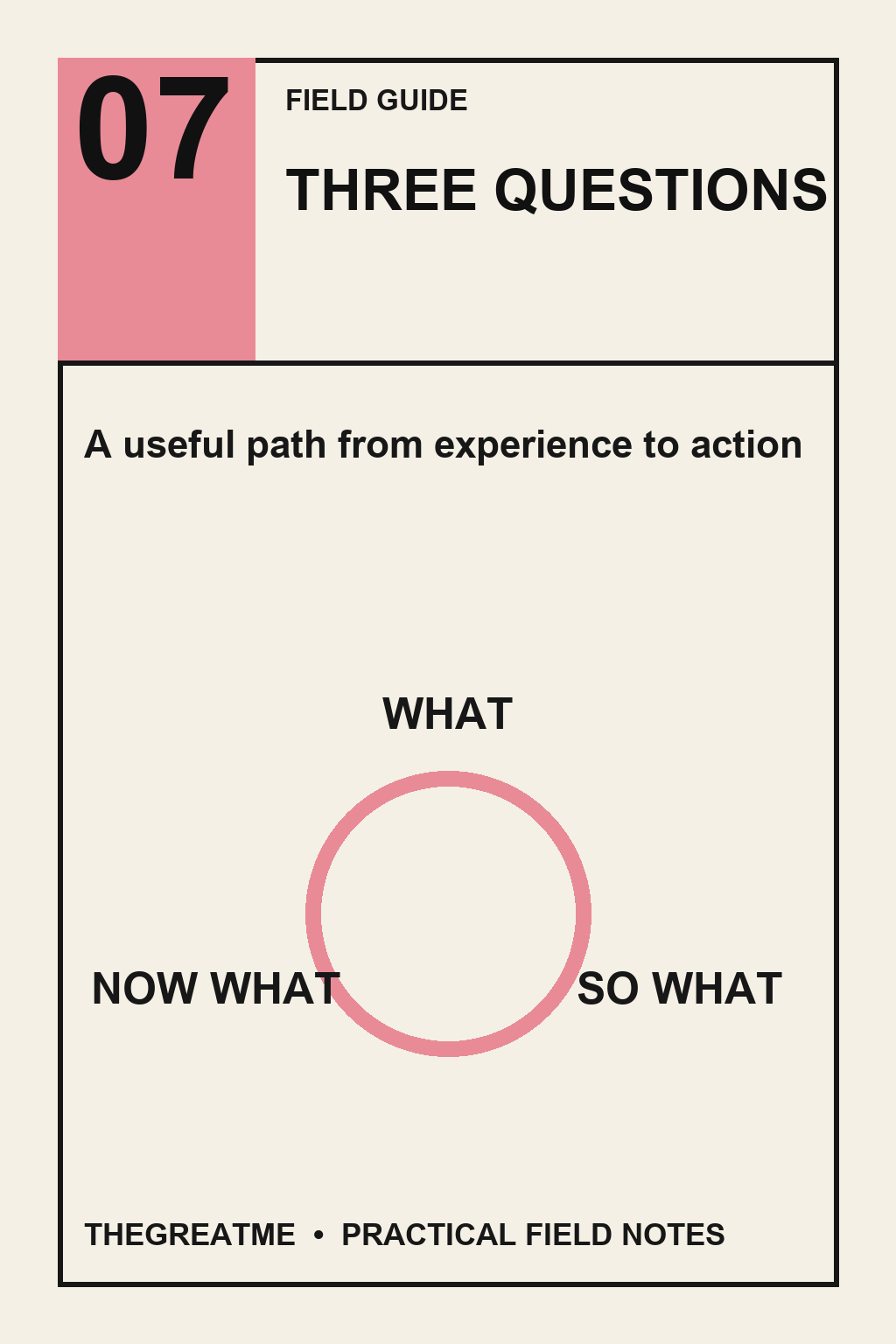
In brief Review anything fast with What, So What, Now What: reconstruct the experience first, extract its meaning, then commit to one concrete, executable next step.
The Opening Question
Does a review have to take an hour? Right after a meeting, a talk, an interview, or a critical piece of work, you often have only a few minutes — and yet your memory is at its sharpest. One of the most practical frameworks for that moment is three consecutive questions:
- What: What happened?
- So What: What does it mean?
- Now What: What do I do next?
The questions look simple, but the order matters. What keeps the analysis anchored to facts. So What keeps the record from stopping at a play-by-play. Now What keeps the understanding from stalling before action. This article's quick version uses a short review to complete all three layers, but complex events deserve more time and evidence.
What Is What–So What–Now What?
What–So What–Now What is a structured reflection model that turns experience into learning in three stages:
What describes the experience. Write the setting, the goal, the participants, your own actions, the result, and how you felt at the time. Feelings are allowed here — but they must be kept separate from observable facts. "They pressed the same question three times" is a fact; "they don't respect me" is an interpretation.
So What builds meaning. Analyze why this experience matters: what assumption, skill, relationship, or process problem it exposed; what knowledge helps explain it; which practices worked; and what you now know that you didn't before.
Now What creates action. Decide what to keep, change, or try next. A good next step names a concrete situation, an action, a time, and a reminder — not "do better next time."
Where It Comes From
The University of Edinburgh's Reflection Toolkit traces the model's lineage clearly: Terry Borton proposed the three basic questions in 1970; John Driscoll developed them into a reflection model in 1994; and Rolfe, Freshwater, and Jasper used and extended the structure in their 2001 book on reflective practice.
Edinburgh notes the model's strengths — easy to remember, broadly applicable — and its limits, which come from the same simplicity. If you write only one sentence per question, the reflection stays shallow. A fast review is not three dashed-off conclusions; the right usage keeps the three questions as the spine and adds follow-up probes at the fact, interpretation, and action layers as needed.
An Illustrative Case
In this fictional example, Chen has just finished a 20-minute project presentation. His manager's closing comment: "The proposal still needs clearer priorities." Feeling deflated, his first instinct was to write "my presentation skills are weak." The three questions got him to something more specific.
What? The goal was to get the team to choose between options A and B. Chen spent 12 minutes on background, 6 minutes on the two options, and 2 minutes on questions. His slides listed pros and cons but contained no recommendation and no decision criteria. When the manager asked, "If you could only do one, which?" Chen answered, "Both matter." The meeting ended with no decision.
So What? The problem wasn't fluency. The presentation's goal was to drive a choice, but its structure was built to transfer background. Chen's hidden assumption was "if I present all the information, the decision-makers will naturally choose" — and reality showed the team also needed explicit criteria and a recommendation. What worked: the cost data for both options went unchallenged and can be reused.
Now What? For the next decision presentation: put "what we need to decide" on page one; cap background at 5 minutes; compare options on impact, cost, and reversibility; state his own recommendation and the conditions under which he'd switch. Before the meeting, ask a colleague exactly one question: "After reading this, do you know what I'm recommending?"
The Method
This article's five-minute version
- Minute 1 — scope it. Pick one specific event. Don't review "my entire recent life."
- Minute 2 — write What. One sentence each for goal, action, result, plus one key moment.
- Minutes 3–4 — write So What. Find the most important gap, one practice that worked, and one interpretation still needing evidence.
- Minute 5 — write Now What. Commit to one action: when, where, and what counts as done.
Deeper probes
At the What layer: What was I trying to achieve? Who did what? What's the evidence? What was I feeling?
At the So What layer: Why does this result matter? Which of my assumptions got challenged? What other explanations exist? What does this say I should continue or stop?
At the Now What layer: When does the next similar situation arrive? What can I prepare in advance? How will I remind myself? What might the new approach cost? How will I know it worked?
Finish each layer by tagging its contents: fact, feeling, interpretation, decision. That one step cuts down on treating feelings as facts — and on treating the first explanation as the only cause.
How to Run It in TheGreatMe
In TheGreatMe, the three-question model works at two speeds: a same-day quick review and a weekend consolidation review.
Right after a key event, use event tracking to capture the What: time, goal, action, and result. At the weekend, use the AI HQ weekly review to separate facts from interpretations and choose the Now What. The app helps preserve and organize the material; it does not determine what the event means for you.
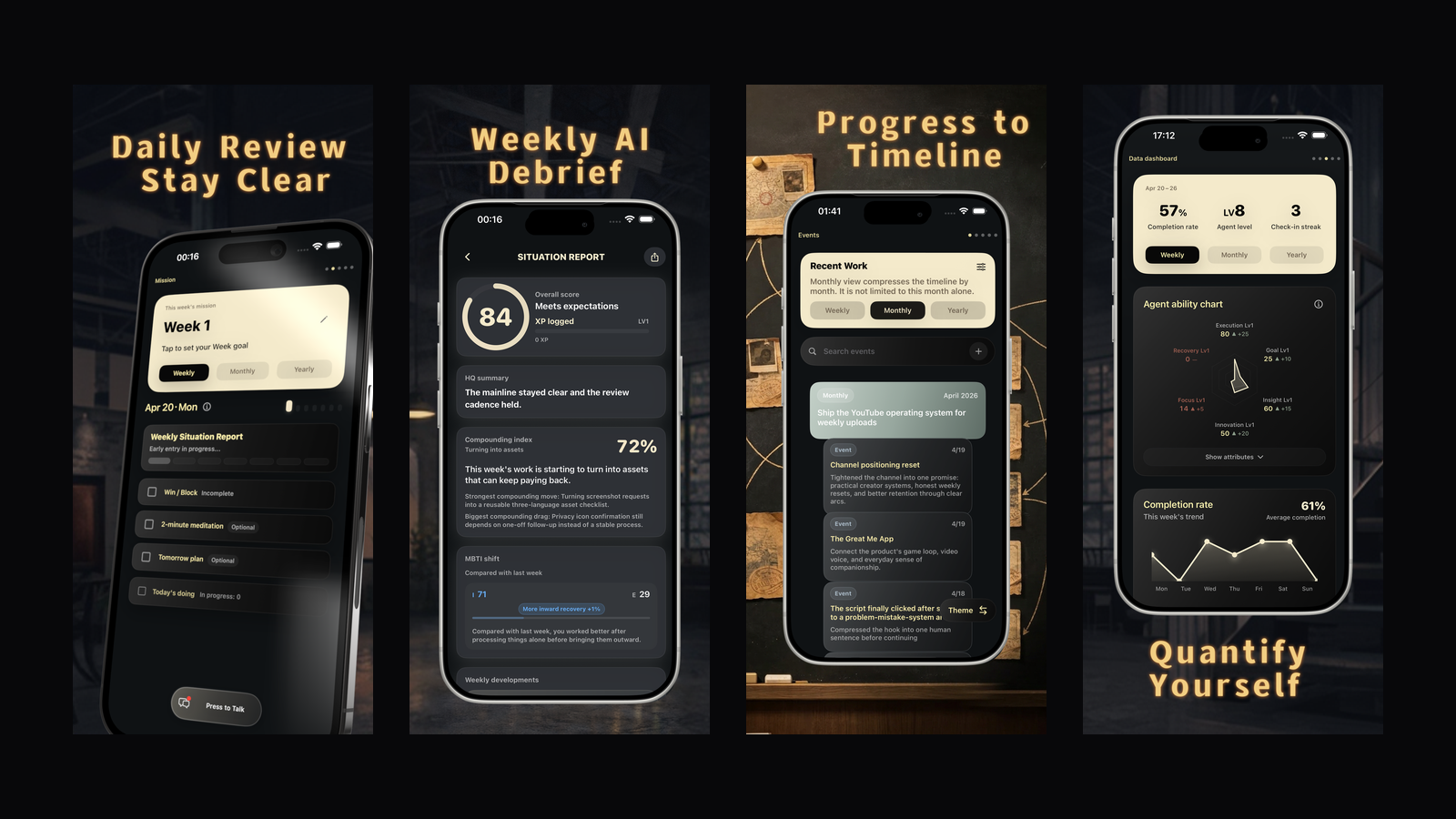
Illustrative English product screens. Values shown are sample app content, not research findings.
Common Mistakes
Watch for this — Writing What as a verdict "The meeting was a disaster" has nothing observable in it. Add the timing, behaviors, results, and original goal before analyzing anything.
Watch for this — Settling on one cause in So What People favor the handiest explanation. This article recommends listing more than one possible explanation and marking how strong the evidence is for each.
Watch for this — Writing Now What too big "Improve my communication skills" can't be executed in the next situation. Change it to "put the recommendation and three criteria on page one before every decision meeting."
Watch for this — Skipping the emotions Emotion isn't the conclusion, but it is part of the experience. After noting "nervous," keep asking: when did it appear, and which actions did it affect?
Watch for this — Deep-reviewing every event High-frequency small events suit the fast three-question version. Long-term patterns, major losses, and complex relationships deserve fuller records and longer reflection.
Start Today
Start here — Check one box and you've started
- [ ] Pick one specific event from today.
- [ ] Write the goal, action, and result in three sentences.
- [ ] Separate the facts from the feelings and interpretations.
- [ ] Write two possible explanations and their evidence.
- [ ] Keep one practice that worked.
- [ ] Choose one action for the next similar situation.
- [ ] Write down its trigger time, reminder, and completion standard.
References
- University of Edinburgh, What? So what? Now what?
- University of Edinburgh, Structured reflections – reflective model
- Borton, T. (1970). Reach, Touch, and Teach: Student Concerns and Process Education. McGraw-Hill.
- Rolfe, G., Freshwater, D., & Jasper, M. (2001). Critical Reflection in Nursing and the Helping Professions: A User's Guide. Palgrave Macmillan.